Introduction
After two years as a Class C amateur radio operator, I finally managed to take the exam for Class B — a plan I actually moved up because Anatel, the Brazilian telecom regulator, recently dropped Morse code from the requirements. I still want to learn it, but it is no longer needed for the exams.
🔵 Note
LABRE-SP, the São Paulo chapter of Brazil’s national amateur radio league, did an excellent job together with Anatel organizing an in-person exam in São Paulo, open to members and non-members alike, and afterwards helped members through all the paperwork. A huge thank you to LABRE-SP, who helped us enormously.
How the exam works
The exam has now moved to a structure of 15, 20 and 30 questions per topic, depending on whether it is for Class A, B or C respectively. It used to be a fixed, widely published question pool with multiple-choice questions, and now it has become an unpublished pool of true/false questions, with the study material published in official documents and handbooks (which I’ll cover further on) and with plenty of practice exams on the internet.
🟠 Warning
Since the question pool is no longer published, memorizing the questions is pointless: now you really have to study the material.
What the exam covers
The content, just like before, is divided into three parts.
Regulations
This part covers the amateur radio rules laid down by Anatel, including things like power limits per class, license validity, callsign allocation and other topics that govern the paperwork required to operate in the country.
Operating Technique and Ethics
In the operating technique and ethics topics we are required to revisit subjects specific to the amateur radio world that help us keep communication clear and build a healthy environment among hams and in radio communications in general.
Electronics
This is, I think, the most technical part, and it was not required for Class C exams but now it is. The topics range from knowing how to read resistor color codes to impedance calculations. It’s a subject I find very interesting, but it can be trickier, since questions may come up that require some calculation and knowledge of electronics formulas such as Ohm’s Law, Kirchhoff’s Laws and others.
How I studied
The study base for the amateur radio exams is the material provided by Anatel, centered on the Cartilha do Radioamador — the amateur radio handbook — along with its resolutions and ordinances. To make my own studying easier, I decided to build, from that material, a practice exam that not only tests you but also helps by explaining the questions and anchoring each one in the material provided by Anatel.
The simulator is openly available, has several options and helps you study topics that haven’t come up yet. It requires no sign-up and no data is collected, everything is stored on your own device, but if you need to, you can export your progress as a file to use on another device.
Access the Amateur Radio Exam Simulator here , where you will also find the Anatel material.
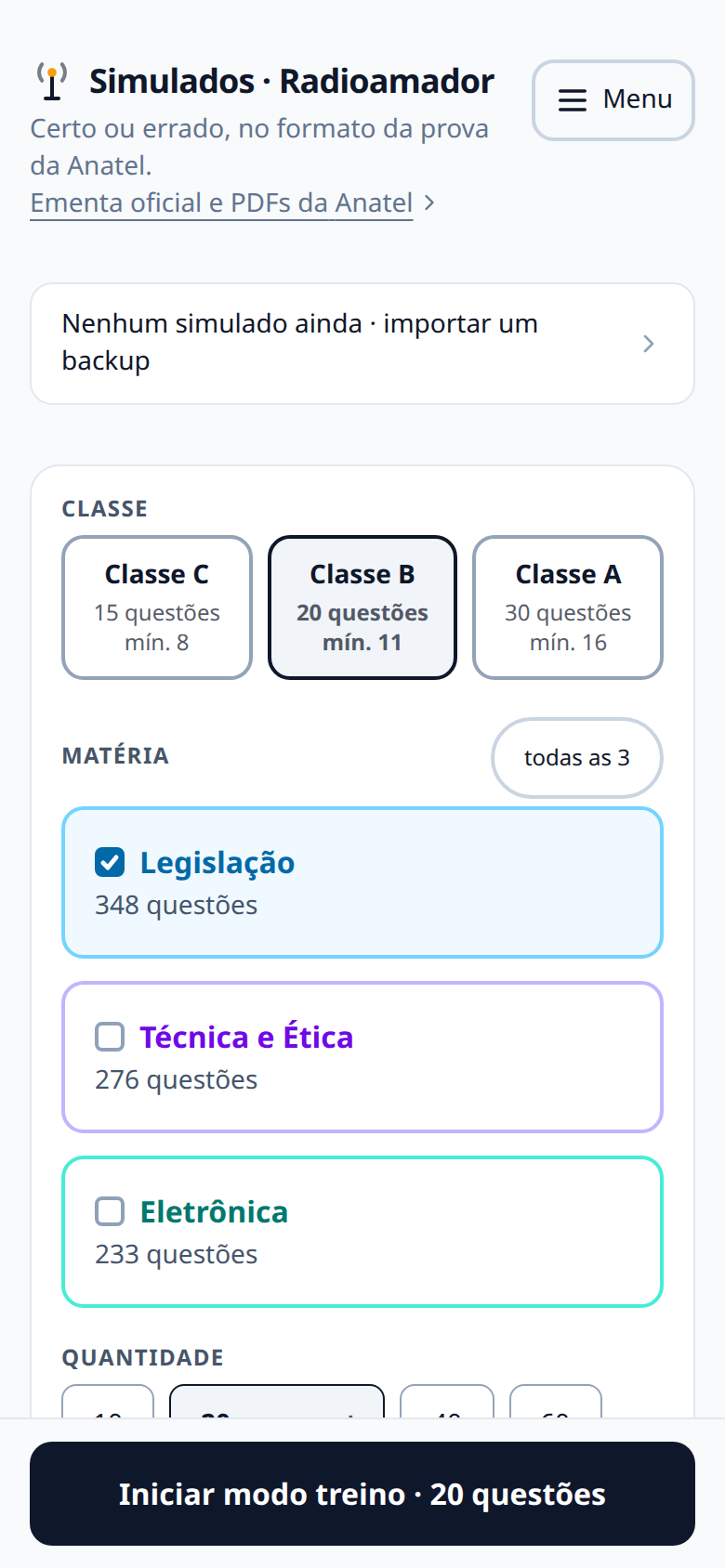
The home screen: pick the class, the subjects and the size of the set.
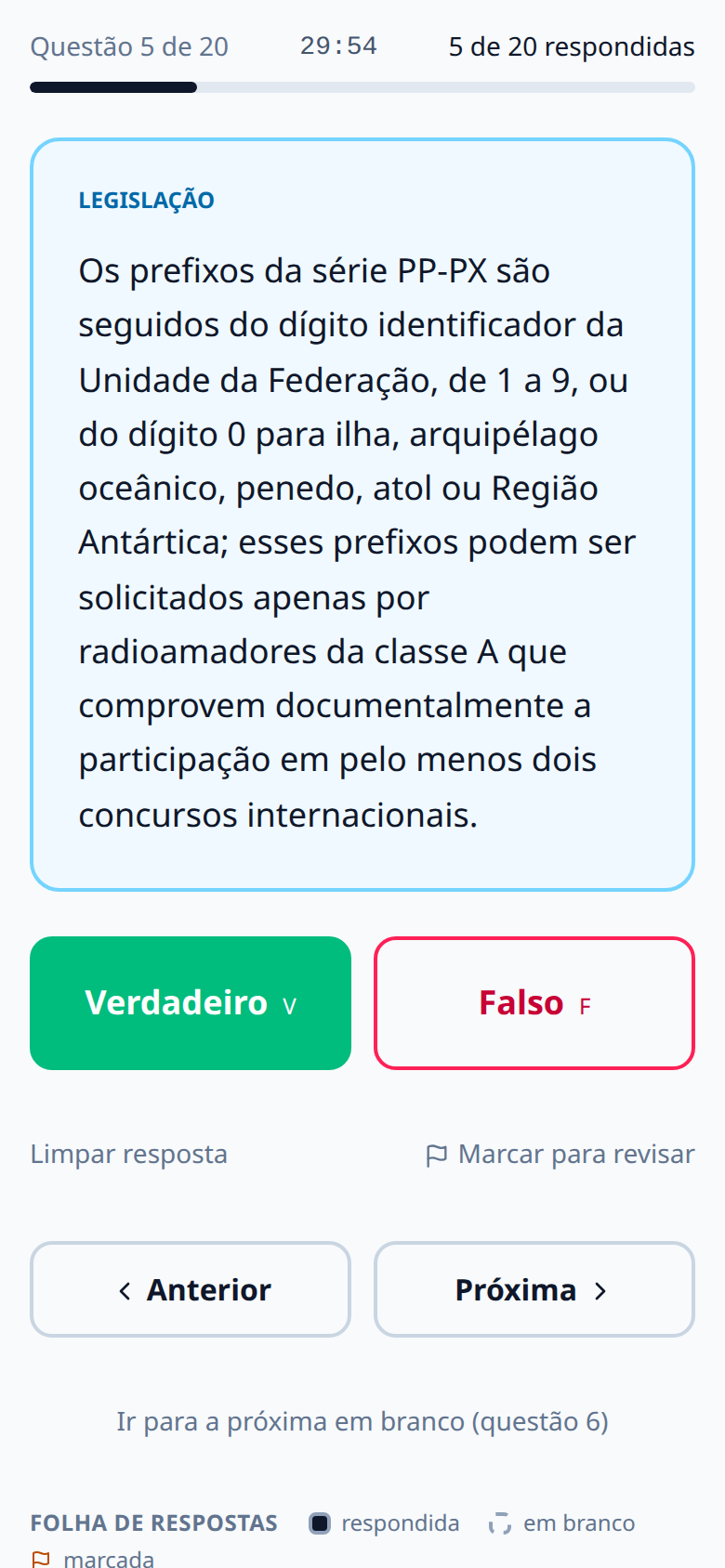
A question in exam mode, with the timer and the progress of the set.
🔵 Note
The simulator is a project of mine and is not official Anatel material. It is meant as study support — the final source is still the handbook, the resolutions and the ordinances.
To build the questions I used artificial intelligence, based entirely on the material, and afterwards reviewed EVERY question by hand, which also helped me study, since I went through all of Anatel’s material. After that I ran more than 150 exam rounds, some complete and others by topic.
Final thoughts
Once again, my thanks to LABRE-SP and Anatel, who organized the exam together. And for anyone thinking about getting into amateur radio, or who feels it is worth going for a class upgrade, the advice is to go for it without worrying. The exam is not trivial, but it is certainly easy to pass if you study through the material, through my simulator or the other practice exams out there on the web, repeating them a few times and checking your results.