Book Review - Antenna Handbook by the U.S. Marine Corps
One of the cool things about amateur radio is that, on its own, it’s not an
isolated field. In fact, it’s a slice of radiocommunications, which in turn are
used both by hobbyists and by industry and the military. Because of that, much of
the knowledge created by one of these areas ends up being very useful to the
others. In this way, even material produced by the military can be useful for
civilians — even from another country — to learn more, and that’s exactly what
caught my attention in the Antenna Handbook by the U.S. Marine Corps, which is
considered publicly available and can be read online
here
.
🟠 Warning
This book is not about amateur radio, so in a few brief moments it may mention practices we shouldn’t follow as amateur operators, such as frequency bands outside our allocation or antennas for specific use. However, its technical knowledge about propagation and antennas is highly connected to our everyday practice, and that’s why I still recommend it.
Cover of the Antenna Handbook (MCRP 3-40.3C)
The book is a basic compendium on radio communication, focused on how antennas work. But what surprised me was that its first chapters don’t deal with antennas, but rather with electromagnetic radiation, atmospheric propagation, transmission lines and many other topics. Something remarkable given its compact size, almost like a pocket book.
Its approach, although broad, is quite direct and doesn’t go into deep electromagnetism calculations, but it’s a good introductory text to several topics of radio transmission.
Overview
The operating frequencies covered range from HF to UHF. For each antenna presented, it shows its radiation pattern, how to size it for a given frequency, basic construction characteristics, propagation, and whether it’s simpler or more complex to build.
I found it very interesting that, despite all the progress in modern links such as satellites and other technologies, the book treats HF as an important part of operations, especially when it dedicates a good portion of its pages to ionospheric reflection and NVIS, with antennas dedicated to these frequencies, covering the band up to 30 MHz several times.
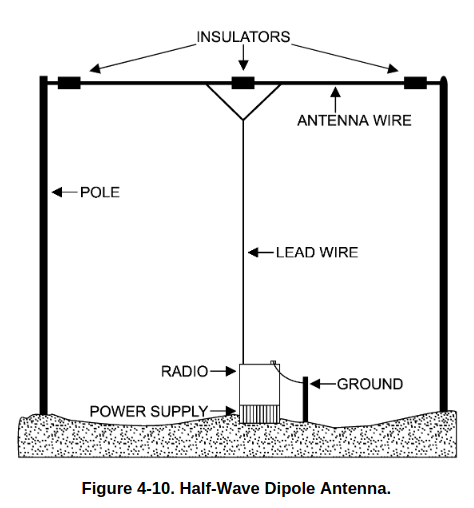
Dipole antenna, as presented in the book
Because it’s a book about military operations and, consequently, talks about field operations, it also becomes interesting for those who do SOTA or POTA operations, as it presents several non-fixed antennas, such as dipoles, inverted Vs, EFHW and many others.
It’s important to point out that this is not an amateur-radio-specific book, and that’s reflected at some points: it mentions military-use frequencies and also covers ways to keep direct communication with other stations without being intercepted. But that’s a detail, since the whole book focuses on the technical aspects of antennas.
So, is it any good?
The book is definitely a well-built manual on radiocommunication, with good practical coverage that brings the theory to the surface when needed to better explain some concepts. I don’t think it’s a book for those still wanting to become amateur radio operators, precisely because, as I mentioned earlier, it doesn’t talk about amateur radio and includes some details that may confuse beginners. On the other hand, it’s a very interesting book for those who have already had their first experiences and now want to expand their knowledge even further. It’s definitely worth keeping on the shelf (if you have a physical copy) and even taking along on remote operations.
Remember that the book is freely available on the Marine Corps’ own website and can be checked out here: https://www.marines.mil/Portals/1/MCRP%203-40.3C%20With%20Erratum%20z.pdf